
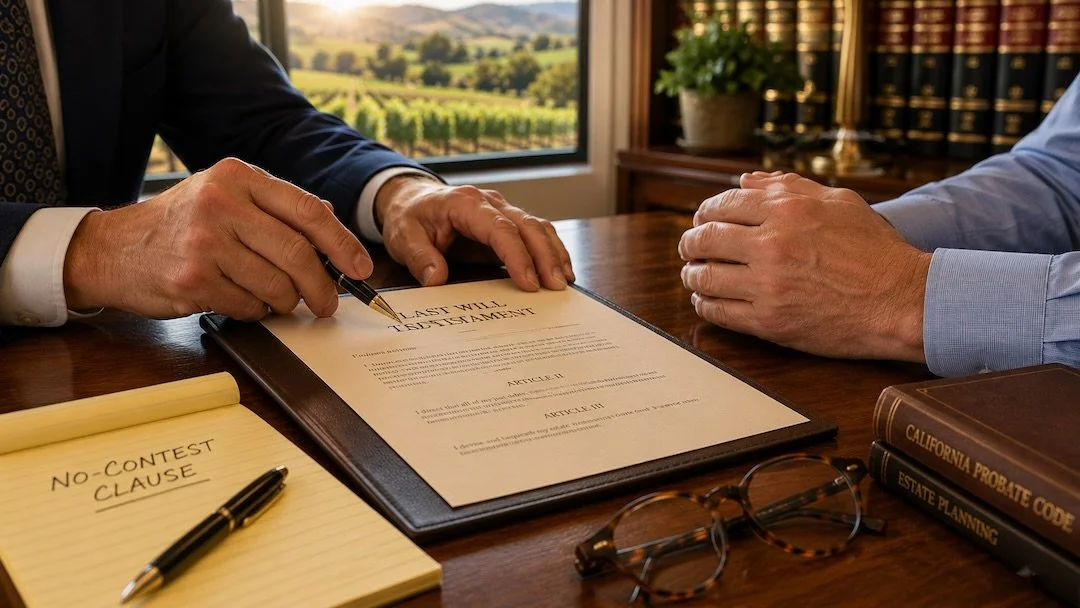
NO-CONTEST CLAUSES & WILL CONTESTS IN CALIFORNIA
Your parent dies. The will is read. A sibling believes they were wrongfully excluded. Another thinks your parent wasn't mentally capable of making decisions. A third suspects undue influence from someone else.
Now everyone's fighting.
And your parent's final wishes—the will—becomes a courtroom battle.
This happens more than you think. Family conflict over wills is common. What's less common is understanding what you can actually contest, what you can't, and what happens if you lose.
California law addresses this directly through no-contest clauses. Understanding them matters if you're writing a will, challenging one, or trying to prevent a contest.

Andrew Kern
Sonoma County Estate Planning, Trust Administration, and Probate Attorney
Jump to…
Get Help With Trust Administration Matters. Request Now
What Actually Happens When Family Members Dispute a Will
A will contest is a legal challenge to the validity of a will. One party (usually a family member) argues that the will shouldn't be enforced because something was wrong with how it was created or executed.
The person contesting files a lawsuit in Sonoma County Superior Court. They claim the will is invalid for reasons like:
The person who made it (the testator) lacked mental capacity
Someone exercised undue influence over the testator
The will contains fraud or forgery
The will wasn't properly signed or witnessed
There's a more recent will
If the court agrees, the will is invalidated. Property goes to whoever inherits under the previous will—or if there's no previous will, California's intestate succession laws determine distribution.
If the court disagrees, the will stands. The person who contested loses and pays their own legal costs.
The problem: this process is expensive, time-consuming, and publicly aired. Everything comes out in court documents that anyone can read.
No-Contest Clauses: What They Actually Do
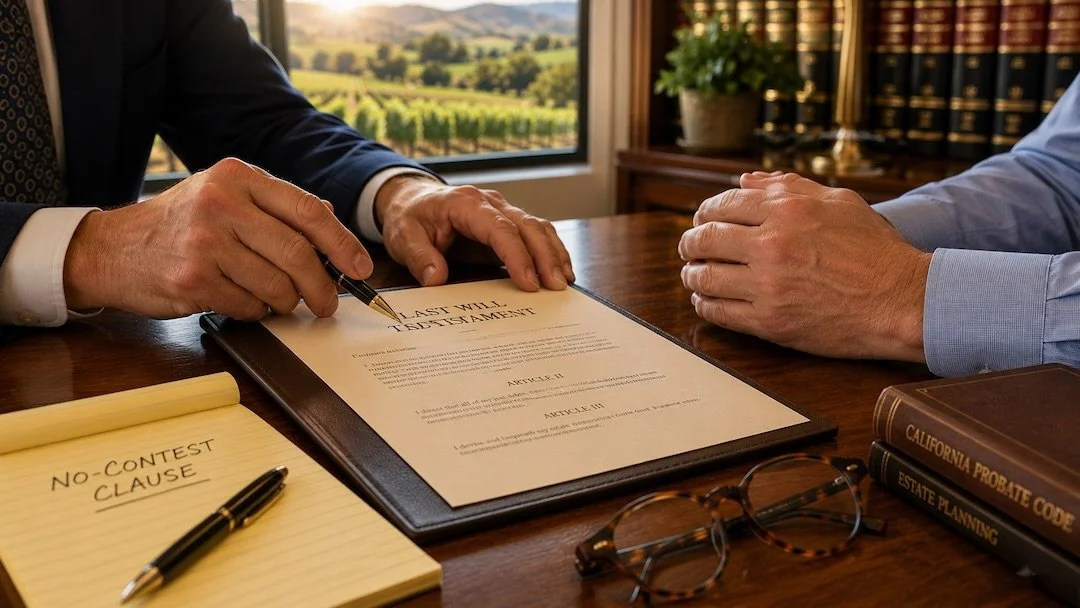
A no-contest clause (called an "in terrorem" clause in legal language) is a provision in a will that threatens to punish anyone who challenges the will.
The language typically reads something like: "If any beneficiary challenges this will, they receive nothing."
The intent: deter family members from suing.
The reality: they sometimes work. They sometimes don't. It depends on California law and the specific situation.
How they function:
If you're named as a beneficiary and you contest the will, and the court upholds the will as valid, the no-contest clause is triggered. You lose whatever you were supposed to inherit—potentially losing far more than you'd gain from contesting.
Example: Your parent's will leaves you $50,000 but gives most of the $2 million estate to your sibling. The will includes a no-contest clause. If you challenge the will and lose, you forfeit the $50,000. The financial punishment is severe.
That's the point. No-contest clauses use financial consequences to stop challenges from happening in the first place.
California's Specific Rules: Probate Code Section 21320
California law governs no-contest clauses. They're not prohibited, but they're heavily restricted by Probate Code Section 21320.
The key rule: A no-contest clause is not enforceable against a beneficiary who contests the will if the beneficiary had "reasonable cause" to contest it.
Translation: Not all challenges trigger the clause. Only certain types do.
What triggers the clause (you lose your inheritance if you challenge):
Contesting on invalid grounds (claims with no factual or legal basis)
Contesting for purely strategic reasons (hoping to settle for money)
Contesting without evidence to support your claim
What does NOT trigger the clause (you can challenge without losing your inheritance):
Per Probate Code 21320, these are exempt from the no-contest clause:
A challenge based on lack of capacity (testator couldn't make rational decisions)
A challenge based on undue influence (someone improperly pressured the testator)
A challenge based on fraud or forgery
A challenge to the will's proper execution (wasn't signed correctly, lacked proper witnesses)
A challenge arguing the will was revoked by a later will
If you fall into one of these categories and you have evidence supporting it, you can challenge the will without triggering the no-contest clause—even if one exists.
California courts recognize that sometimes, challenging a will is the right thing to do. The law protects that right.
Valid Grounds for Contesting a Will
California recognizes five main grounds for contesting a will. Understanding these matters because they determine whether you're protected from the no-contest clause.
1. Lack of Mental Capacity
The testator didn't understand what they were doing when they signed the will. They didn't know the will's contents, didn't understand who their family members were, or couldn't grasp their property's extent.
This is common with dementia, Alzheimer's, or cognitive decline. It requires medical evidence or testimony.
2. Undue Influence
Someone (usually close to the testator) used pressure, manipulation, or coercion to get the testator to write a will favoring them.
Classic scenario: An adult child isolates their elderly parent and convinces them to leave everything to that child instead of their spouse or other children.
This requires evidence of the relationship, opportunity, and unusual provisions that favor the person alleged to have exerted influence.
3. Fraud
The testator was tricked. They signed something believing it was one document when it was actually another. Or they signed the will based on false statements (someone lied about what was in it).
4. Improper Execution
The will wasn't signed properly. California requires:
The testator's signature
At least two witnesses present at the same time
Both witnesses signing the will
If any of these are missing, the will might be invalid.
5. Revocation
A later will exists that revokes the earlier one. Or the testator destroyed the will intentionally, which revokes it.
Common Reasons Wills Get Contested
Understanding why family members contest helps you plan defensively.
Unexpected exclusions. Someone expected to inherit—a child, grandchild, or long-time caregiver—was left out entirely. They believe this was a mistake or due to undue influence.
Unequal distribution. One child gets significantly more than siblings. The others feel this was unfair and suspect the favored child manipulated their parent.
Late-life changes. The will was changed shortly before death, particularly favoring a new partner or caregiver the family doesn't trust.
Cognitive decline. The testator's mental health was declining near the end. Family members question whether they still had capacity to make sound decisions.
Isolation. One family member isolated the testator from others, then changed the will in their favor.
Secret relationship. An unknown beneficiary appears in the will—sometimes a secret child or partner—and other family members contest.
Financial pressure. Someone in the will was heavily in debt or facing financial crisis. Family suspects they pressured the testator.
These situations don't always result in successful contests. But they're why contests happen.
The Real Cost of Will Contests
People underestimate what will contests actually cost.
Financial cost:
A simple will contest runs $5,000-$15,000 in attorney fees if it settles quickly. Most don't settle quickly. Contested cases typically cost $25,000-$50,000 in legal fees for one party. If both sides hire attorneys, the total legal cost can exceed $100,000.
Court costs, expert witness fees (for capacity evaluations or financial analysis), and deposition costs add up.
Time cost:
Will contests take 12-24 months to resolve. Some take longer. During that time, the estate is frozen. Beneficiaries can't get their inheritance. Real property can't be sold. Assets sit in limbo.
Relationship cost:
Will contests destroy families. People who might have reconciled never do. Siblings who could have maintained a relationship become permanent enemies. Cousins take sides. Thanksgiving becomes impossible.
Even when someone "wins" a will contest, they've lost their family.
Emotional cost:
Being accused of fraud or undue influence is traumatizing. Being excluded from a will you expected is devastating. The stress of litigation is severe.
How to Protect Your Will From Contest
If you're writing a will, you can reduce contest risk with help from a probate attorney who specializes in estate planning.
Include a no-contest clause. If you want to, include one. It won't prevent all challenges, but it discourages frivolous ones.
Document your capacity. Get a letter from your physician confirming you're mentally competent when you sign the will. This prevents later claims that you lacked capacity.
Explain unequal distributions. If you're leaving more to one child than another, consider a brief written explanation. "I'm leaving more to Sarah because she has cared for me for five years" or "I'm leaving less to John because I already funded his business." This shows your reasoning wasn't influenced by anyone else—it was deliberate.
Sign the will with proper ceremony. Follow California's requirements exactly: your signature, two witnesses present at the same time, both witnesses signing. Video record the signing if possible, with you stating you're doing so voluntarily and of sound mind.
Use an attorney. Self-made wills (holographic wills) are legally valid in California but are challenged more often. An attorney-drafted will with proper execution is harder to contest.
Avoid isolation. Don't suddenly cut family members out of your life right before you write a will. This signals undue influence to later challengers.
Update your will periodically. If you make changes, explain why. "I'm updating my will dated 2015 because my circumstances have changed."
Consider a trust instead. Living trusts are more difficult to contest than wills because they're not made public and courts have less authority to overturn them. If you're worried about contestation, a trust might be better.
What to Do If You're Facing a Will Contest
If you're the executor of a will that's being contested, or if you're a beneficiary and someone's suing:
Get an attorney immediately. Don't represent yourself. A probate attorney who handles will contests is essential.
Preserve evidence. Don't destroy documents. Keep originals of the will, any drafts, communications with the testator, and documents showing the testator's state of mind.
Respond promptly to court filings. Missing deadlines can result in losing by default.
Evaluate settlement. Most will contests settle before trial. Your attorney can advise whether settling makes financial sense.
Understand the burden of proof. The person contesting the will must prove their claim. It's not enough to suspect something was wrong—they need evidence.
Stay calm. Don't communicate with the person contesting the will directly. Let your attorney handle all communication.
Not sure if you have a valid claim? A probate attorney can review your situation and tell you whether contesting makes legal and financial sense.
The Takeaway
No-contest clauses work in California, but only partially. They prevent some challenges but can't prevent valid ones based on lack of capacity, undue influence, fraud, improper execution, or revocation.
If you're writing a will, protect yourself with proper documentation and execution. If you're facing a will contest, get legal help immediately.
If you're considering contesting a will, understand that valid grounds exist. California law protects your right to contest if you have reasonable cause.
Family conflict over wills is painful and expensive. The best strategy is preventing it through careful planning. Or if you're already in the conflict, handling it with professional guidance.
Call Law Office of Andrew Kern at (707) 658-4602 if you need help writing a will with proper protections, or if you're facing a will contest. We serve Sonoma County families navigating these difficult situations.
Don't let family conflict over your will destroy your legacy—or don't let a contested will destroy your future. Call today.